





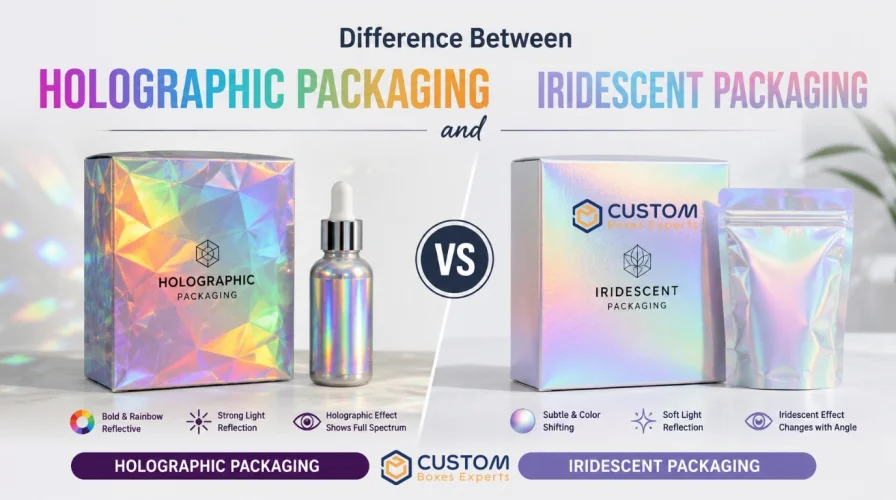
Open up any retail aisle or watch any unboxing video, and shiny, color changing boxes are everywhere! Brands will adore the effect, but the majority of people use holographic and iridescent interchangeably.
They do not. The two effects are of differing technology, and selecting the wrong effect can be time-consuming for retail packaging that is not the desired appearance of a brand.
What Is Holographic Packaging
Packaging is holographic when a microscopic diffraction pattern is etched into the foil or film. When light strikes that pattern and refracts into a complete rainbow, it gives a 3-D effect, which appears to shift with the turning of the box.
How the Holographic Effect Works
This is why Holographic Boxes seem to come to life in the stores. The pattern is not a single changing colour, but a multi-coloured pattern.
Common Uses for Holographic Finishes
Cosmetics and skincare launches
Limited edition retail drops
Gift boxes and event packaging
Tech accessories that want a futuristic look
What Is Iridescent Packaging
Iridescent packaging is not by diffraction, but by thin film interference. Light waves reflect within a coated material and vary in colour according to the angle that it is viewed from.
How the Iridescent Effect Works
This results in a smoother and more muted transition from one shade to the other. The box takes a blue hue as it moves, with no 3D pattern or depth illusion. The surface remains flat and visible as opposed to holographic film.
Common Uses for Iridescent Finishes
A subtle shimmer instead of a bold sparkle
Pastel or soft color transitions
A premium look without an overly loud finish
Packaging for delicate or minimalist product lines
Holographic Boxes vs Iridescent Boxes: The Core Difference
The easiest way to separate the two comes down to depth and movement.
Key Technical Differences
Holographic surfaces show a rainbow spectrum with visible 3D texture
Iridescent surfaces show a smooth, single direction color shift
Holographic film uses diffraction gratings
Iridescent coatings use interference layers, closer to oil on water or a soap bubble
Suppliers of retail packaging supplies sometimes label both effects as "holographic" in product listings, which creates confusion for buyers who actually want one specific finish.
Choosing the Right Finish for Retail Boxes
Retail packaging decisions should start with the product's shelf environment, not just personal preference. A bold holographic finish on Display Boxes for Retail grabs attention fast under bright store lighting, which works well for impulse buy sections and counters.
When Iridescent Works Better
Iridescent packaging is a better option in cases where the brand is more interested in style than in shock value. Fashion lines such as jewelry and skin care are often inclined to the softer style of shimmer, as that gives the impression of more high-end.
Questions to Ask Before Deciding
Where will the product sit, shelf, counter, or online unboxing
Does the brand identity lean bold or minimal
What lighting conditions apply in store
Does the finish need to match existing packaging in a product line
Comparison Table
Feature | Holographic Packaging | Iridescent Packaging |
Visual effect | Rainbow, 3D depth illusion | Smooth single hue shift |
Technology | Diffraction grating film | Thin film interference |
Best for | Bold, eye-catching retail boxes | Soft, premium minimalist packaging |
Common finish | Foil stamping, laminate | Pearlescent or opal coating |
Typical industries | Beauty, tech, limited editions | Skincare, jewelry, luxury gifting |
Custom Retail Boxes and Print Quality
The quality of printing and lamination plays an important role in achieving a premium holographic finish. Choosing the right printing method can improve color accuracy, detail, and overall packaging appearance, while a high-quality laminate helps maintain the finish over time. To better understand which printing method is right for your custom packaging, explore our guide to CMYK vs. PMS vs. Digital Printing for Custom Boxes.
What to Check Before Bulk Ordering
Custom retail packaging boxes that use these finishes should be built on solid board first, then laminated properly. The base material matters as much as the surface effect.
Board thickness and rigidity
Lamination type, gloss or matte base layer
Scratch-resistant coatings on holographic film
Storage conditions before the box reaches the customer
Buyers ordering Custom Boxes Wholesale should always request a physical sample before committing to a full production run, since screen mockups rarely show the true shine or texture.
Custom Retail Boxes With Logo and Brand Visibility
A shiny finish is never meant to cover the brand logo up. With custom retail boxes and logo printing, it is important to have enough contrast between the hologram/iridescent surface and the location of the logo otherwise, the logo will not show under the shine.
Fixes That Keep the Logo Visible
White ink base layer under the logo to block the shifting color
Debossing or foil stamping for the logo instead of flat print
Spot holographic application, only on part of the box, not the whole surface
Matte finish around the logo area to create contrast
This approach works whether the order is for custom packaging for retail launches or an ongoing product line that needs consistent branding across every batch.
Conclusion:
While many packaging listings use the terms interchangeably, they are not synonymous; holographic and iridescent are not interchangeable. Holographic film produces a rainbow and a 3D depth effect, achieved by diffraction, and iridescent coatings produce a colour shift in a single direction, achieved by interference.
The finish selection will be dependent on the brand appropriation, product classification and shelf location within the box. Having this information correct before placing bulk orders for custom product boxes can save money and prevent getting the finish that isn't what the brand is looking for, which is why working with Custom Boxes Experts early in the process makes such a difference.