





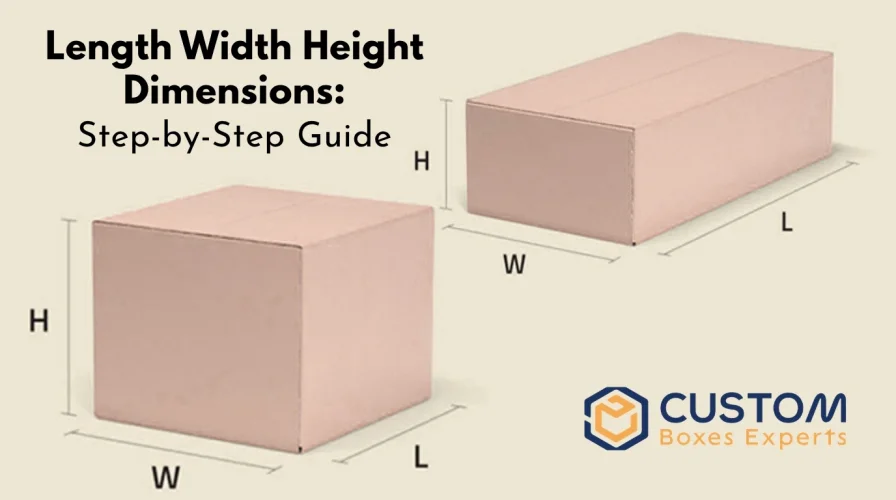
Imagine your premium product gets ruined due to oversized packaging. Worse, the box might be so tight that your delicate item gets damaged or stuck inside. Ordering Custom Boxes requires a clear understanding of width, length, and height. Accurate dimensions protect your products, optimize storage space, and significantly lower your shipping costs.
Every millimeter counts when you try to protect fragile retail goods during transit. This step-by-step guide teaches you how to measure box dimensions like an industry professional.
Importance of Dimensions For Custom Boxes
Packaging serves as the primary shield for your retail products during rough transit. Minor errors like oversized or tight boxes will quickly affect your whole business reputation. Correctly sized boxes ensure zero empty space inside the structural volume of your package. This tight layout prevents items from shifting around during shipping and handling stages.
How Sizing Impacts Your Shipping Bills
One other major impact that comes with the correct dimensions is the decrease in the cost of transportation. The large global freight carriers utilize a sophisticated method of pricing known as Dimensional Weight (DIM weight). DHL and FedEx calculate shipping fees based on the actual volume a package occupies. Making your boxes accurately according to the needed dimensions saves enormous supply chain expenses.
What are the Length, Width, and Height of the packaging?
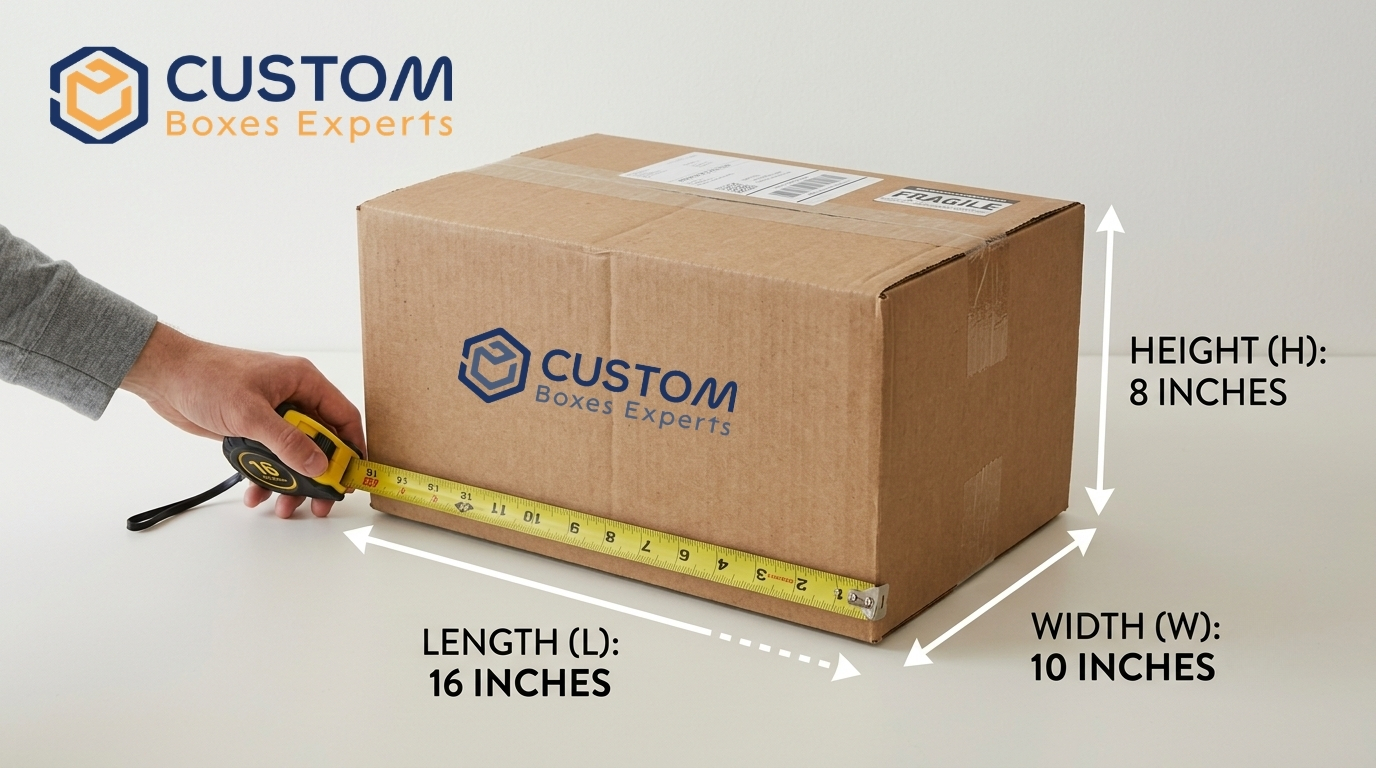
The conventional math formula computes the exact cubic volume of all physical objects. The industry experts use the formula of length, width, and height to compute the customized packaging sizes. Knowledge of these three separate axes will save you from misunderstanding with your manufacturing partners. Let us explain the meaning of these terms for your daily business activity.
Defining Length, Breadth, and Height
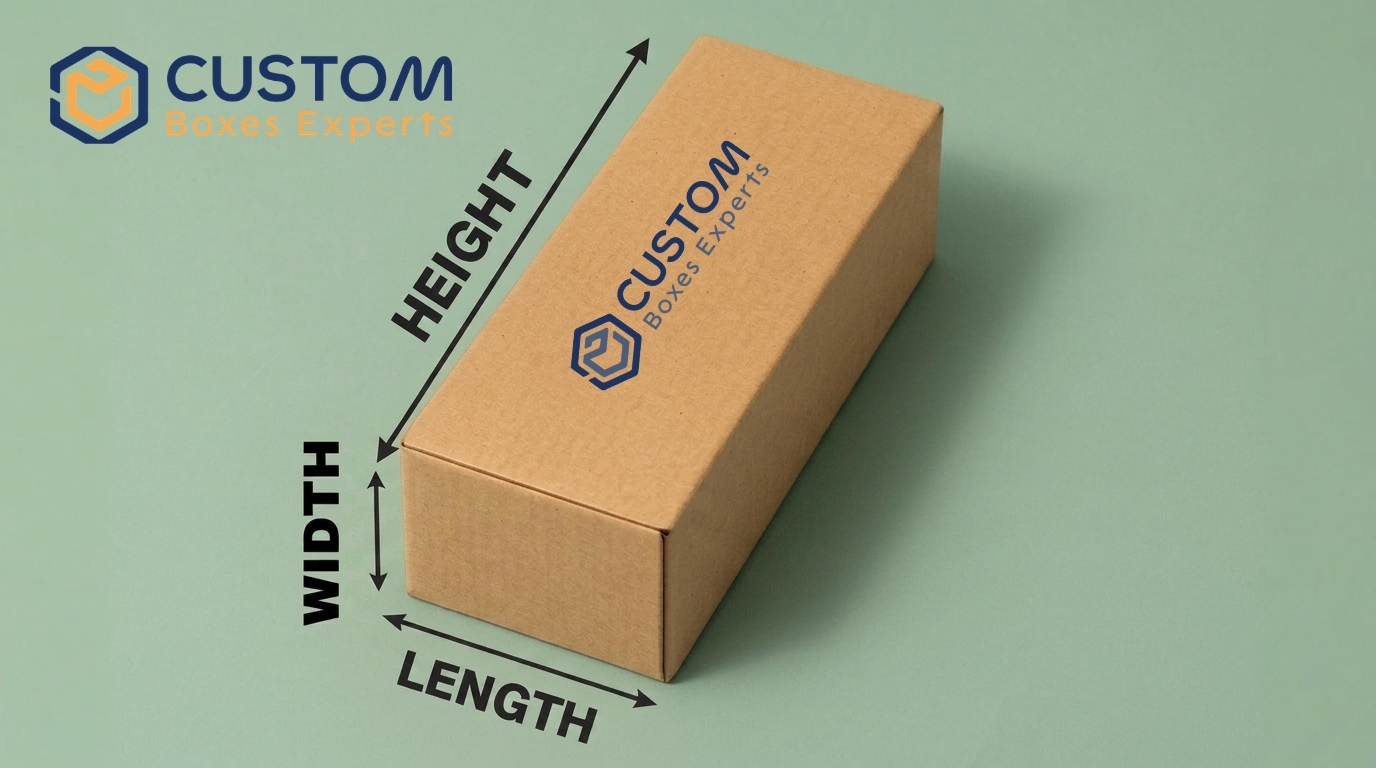
The longest side of the product or box base determines the overall length. You must always look at the box from the top view to identify this primary dimension. The shortest side of the box base is called the packaging breadth or width. This specific dimension runs perfectly perpendicular to the length of your container. Finally, measuring the vertical distance between the base and the top edge gives you the height.
Step-by-Step Guide on How to Measure a Box
Measuring the Breadth and Height
Turn your attention to the shorter side of the box base to find the width. Place your ruler perpendicular to the length line and measure from front to back. Record this second number carefully as your official packing size width. Extend your measuring tape vertically from the bottom base to the very top edge. Keep the tool perfectly straight and write down this third final dimension clearly.
How to Measure the Volume of a Box?
The measurement of the size of the box based on its volume is useful for brands in calculating their correct dimensional weight. One will require all three different dimensions to calculate its actual volume. This can be done through the simple mathematical equation, which is:
Volume = Length x Width x Height
Practical Example of Volume Calculation
Let us consider a standard rectangular shipping box for a practical business example. This specific box has a 16'' length, 12'' width, and 12'' height. Applying our standard formula gives us Volume=16×12×12. You will find that this standard shipping box's volume is exactly 2,304 cubic inches.
Two-Dimensional vs. Three-Dimensional Boxes
Two-dimensional packaging options feature only length and width without any structural depth. Flat document folders, paper envelopes, and canvas mailer sleeves represent common two-dimensional shapes. These items protect flat products that do not require any corner cushioning during shipping. Three-dimensional boxes feature measurable volume, depth, and distinct structural corners like shoeboxes and cereal cartons. Choosing between these types of boxes depends entirely on your product shape.
Order of Length, Width, Height In a Box
The standard commercial order to measure a box's dimensions is strictly Length x Width x Height. However, the specific measurement order sometimes shifts based on the physical orientation of your packaging. Let us analyze how different industries read these dimensions for unique structural designs.
Height Width Length Order
Brands utilize the height, width, and length order primarily for tall vertical boxes. Medicine bottles, cosmetic spray cans, and beverage boxes use this vertical measurement sequence. Manufacturers list the vertical height first to emphasize the vertical standing plane of the item. Every brand has a different size guide and follows the measuring techniques accordingly.
Height Length Width Order
The Height, Length, and Width sequence applies directly to objects or boxes that lie flat in a horizontal shape. Pizza boxes and laptop shipping containers often follow this horizontal measurement notation style. You can start measuring the height first, and then the length and width. The order could be different, but the formula applies the same way to calculate cubic size.
Length Height Width Order
Viewing a box from the direct side panel requires a length, height, and width order. Look at the box from its front panel and turn it to 90 degrees. Now start measuring the length, which is usually smaller than the height and width. This perspective helps engineers calculate structural load limits for stacked warehouse boxes.
Length Vs Width
If we talk about cubes and rectangular prisms, length and width are at right angles to each other. From the front, both these dimensions combine to give a two-dimensional image to objects. The length and width of product boxes decide how long and wide products can be packed inside the packaging boxes.
Width Vs Height
Width and height are also positioned at right angles to each other in structural packaging. However, the front view often completely hides the overall depth of a cuboid or rectangular prism box. These two dimensions combine to decide the depth and width of items accommodated in your packaging boxes.
Height Vs Length
Like width vs height, length also shadows the height of a cube from the front view. Dimensions of products from left to right and front to back are determined by these specific sides. These combined metrics tell you exactly how the product will shift internally during bumpy transit journeys.
Difference Between Length, Width, Height
Dimension | Description (Front View) | Cereal Box Example | Main Purpose |
Height | The vertical distance from the very bottom base to the top edge. | The tallest, upright part of the box is facing you. | Determines how tall the product can be. |
Width | The horizontal distance is measured from side to side (left to right). | The face of the box where the brand name/logo usually is. | Determines how wide the product can be. |
Length (Depth) | The distance from the front panel to the back panel. | The side panel is visible when you rotate the box 90 degrees. | Determines the thickness or depth of the space inside. |
Real-World Dimensions of Everyday Items
The average dimensions of an ordinary commercial cereal box include 12 inches in height, 7.5 inches in length, and 2 inches in width. Likewise, the average dimensions of an ordinary man’s shoe box consist of 14 x 10 x 5 inches. These everyday factual benchmarks show how the three dimensions scale across different consumer goods.
Measuring Internal Dimensions of a Box
Since you have explored finding three dimensions of your box, keep one crucial aspect in mind. You should always measure the internal dimensions of your box for accurate production. The packaging box dimensions of the industry standard box depend on internal measurements instead of external ones. The reason for relying on internal measurements is that they fit your products snugly.
Internal Vs External Dimensions of Boxes
Calculate the internal dimensions of the box if you want to know the usable space inside. These measurements are important when you want snug fit sizes for fragile goods. External dimensions, on the other hand, denote the overall exterior dimension of the box. This will be used mostly to facilitate shipping and delivery calculations.
Tools for Measuring Length, Width, and Height
Accurate measurement of the box is important to ensure your product fits properly within the box. What you need is a tool that will help you come up with the accurate length, breadth, and height of a box. A specialized caliper can be used to measure the thickness of the cardboard. Rulers measure length, width, and height separately, whereas measuring tapes measure perimeter.
How to Note the Dimensions Correctly
While determining dimensions for the box, it becomes essential to follow the right order in order to determine accurate results. Note the measurements according to the Length x Width x Height method. Let us take the example of a customized mailer box which measures 16" x 12" x 8". You must note it down as: Length: 16 inches, Width: 12 inches, Height: 8 inches.
The Issue of External Dimensions
Aside from the internal dimensions of a box, which are usually simple, external dimensions bring unique challenges. Since not all boxes are crafted equally, some are more cubical while others have sophisticated structure designs. When it comes to crafting complex box setups, each outer dimension counts heavily. Any external miscalculation directly impacts the entire structural integrity and shipping costs of your batch.
Common Mistakes to Avoid When Measuring Box Dimensions
Most of the packaging goes to waste during manufacturing due to mistakes in measuring dimensions. Some people write height first, while others confuse width and depth. To avoid such errors, always follow the standard Length x Width x Height formula. Always use the same unit for all measurements and double-check before placing your official packaging order.
Expert Tips: How to Pick the Right Box Size
Selection of the proper package size begins with a determination of the physical measurements of your product. The package should fit the product without any unwanted air space left. Begin by determining the largest measurement for your product’s length, width, and height. For a snug fit, add exactly 2–3mm of extra space inside the inner dimensions.
Space for Padding and Insulation
When one decides to use bubble wrap or tissue paper as padding material, one should add 1-2 cm clearance to ensure enough clearance without interfering with the custom-made outer box. Keep a gap of 2mm between items to avoid surface friction damage while transporting multiple products.
Why Box Dimensions Matter More Than You Think
The dimensions of a box are value-based numbers that determine the actual size of your package. If any value is mismeasured, it can ruin the entire packaging persona instantly. Issues include a massive surge in shipping costs, compromised product safety, and poor customer reviews. Inconsistency in packaging signals poor quality assurance, making customers rethink their next brand purchase.
Ready to give your products the perfect fit? Contact Custom Boxes Experts today to eliminate shipping waste and protect your brand!
Get Your All-Personalized Food Packaging!
Turn your food company into a premium packaging company with Custom Boxes Experts. Our packaging is long-lasting, safe, and customizable to the full extent to ensure your products are safe and your brand image is well-developed.
Whether you require Chinese Takeout Boxes, frozen food boxes, or high-end food packaging. We offer solutions to your needs. In order to get a custom quote to enhance your packaging strategy!
FAQs
What comes first in dimensions, length, width, or height?
The packaging industry always lists the length first in the standard dimension sequence. The official universal order for notation is always written as Length x Width x Height.
How can you determine the height of a box?
To determine the height of the box, position it horizontally on the flat table and locate the vertical corners. Then measure directly from the bottom baseline to the top flap edge.
What does l x w x h stand for in the correct sequence?
Length multiplied by width and height in the correct sequence means l x w x h. With this sequence, manufacturers will be able to know about your package requirements properly.
What are the differences between internal and external dimensions?
The internal dimensions indicate the inner space of the box to ensure an appropriate fit of the items inside the box. While external dimensions indicate the exterior of the box, which helps in calculating the shipping charges.