





The choice of packaging is one of the biggest decisions you need to make for your expanding company. The packaging needs to be secure, professional, and affordable. While there are so many types of custom packages out there, there is one type that catches on easily, and that is the tuck box.
These packages are highly in demand among the retail, ecommerce, and shipping sectors. They possess a very distinctive appearance, utility, and aesthetic appeal. Let us explore this beginner's guide for understanding the concept of tuck boxes and their significance for your brand.
What Is a Tuck Box?
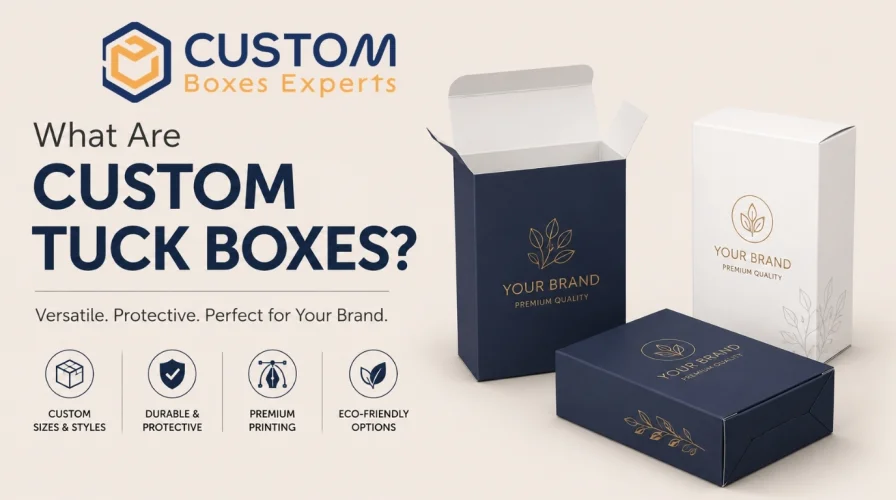
A tuck box is a lightweight box used for packaging purposes and has flaps on either the top or bottom. The flaps of a tuck box are inserted directly into the box body to form a seal.
The most distinguishable characteristic of a tuck box is that it doesn’t need glue, tape, or staples to maintain its seal. Therefore, it is very clean to open.
Custom Tuck Boxes are normally used by companies to package lightweight products since they are highly desirable due to their neat look and ease of assembly.
The History and Evolution of Tuck Boxes
Tuck boxes first appeared in the 20th century as a simple way to store small, lightweight items. Early designs were basic and purely functional.
However, there have been tremendous advancements in paperboard technology over the years. The emergence of folding cartons was revolutionary in the packaging process for firms.
In today’s world, folding cartons are stronger and environmentally friendly, and can also be customized depending on their different uses.
Why Tuck Boxes Are So Important
Tuck boxes are universally known for their effectiveness in storage, display, and protection of items. They give the product a sophisticated look that improves the entire shopping experience.
With endless possibilities for customization, the boxes can act as an effective means of marketing for your business. One can use these customized boxes for communicating your brand identity. This box has everything that needs to be there in the perfect pack.
Rigid Boxes vs. Tuck Boxes
Choosing between a rigid box and a tuck box depends entirely on your product's needs, weight, and your brand's budget.
Rigid Boxes: These kinds of boxes are very thick and sturdy and collapse. They are designed to ensure maximum luxury and strength. The brand utilizes this type of box for valuable products such as jewelry, luxury cosmetic and electronic devices.
Tuck Boxes: These kinds of boxes are made using very thin cardboard. These can be sent flat and are highly affordable, eco-friendly, and economical to store in large quantities.
Though rigid packaging is an ultimate luxury, tuck packaging provides unmatched versatility and affordability in regular retail stores.
What Are Custom Tuck Boxes Made Of?
To ensure that your packaging is light and strong, manufacturers make use of quality paper material.
Paperboard
This is the most commonly used material for retail products. It is smooth, lightweight, and great at holding bright prints on it.
Kraft Stock
Kraft stock is an organic and biodegradable product. This is the best option for companies that would like to give an image of going green.
Cardboard and Corrugated Board
For heavier products, thick cardboard or lightweight corrugated board is used. This is done to add more structure to the box and avoid its bending.
Popular Types of Tuck Boxes and Their Functionality
Different products require different closure styles to ensure they stay secure. Let us look at the most common types.
Straight Tuck End
For straight tuck end boxes, both the top and bottom flaps fold toward the exact same side of the box. This design creates a highly clean and symmetrical look on the front. It is widely used for cosmetics, perfumes, and small electronics because it looks incredibly neat on retail shelves.
Reverse Tuck End
For reverse tuck end boxes, there is folding of the flaps in opposite directions. In this case, one flap will fold towards the front, while another will fold towards the back. Due to this structure, the boxes can be assembled closely within the manufacturing sheet, thus conserving paper and reducing costs. These boxes are widely used in pharmaceuticals, toothpaste, and home supplies.
Snap Lock Bottom
This style features a standard tuck top but has a specialized bottom. You manually fold four interlocking flaps at the base to lock them in place. It offers additional support to the bottom, thus being highly economical for medium-weight retail products.
Auto-Lock Bottom
These are also referred to as auto-bottom boxes, which have pre-glued bottoms that automatically fit during the assembly process of the box. The advantage of the bottom is that it gives maximum strength to the bottom and also increases the speed of packaging. It is the best box for packaging heavy products.
Tuck Top Mailer Boxes
These boxes have a flat bottom and a single tuck flap on the top panel. They are designed for fast manual assembly and daily packaging needs. You will often see them used for subscription boxes or fast e-commerce shipping.
Playing Card Boxes
They are specially made tuck boxes that will perfectly hold a complete deck of cards. They are sturdy, convenient to open, and well-made. Most come with a plastic viewing window on the front to allow customers to see the cards inside.
Straight Tuck vs. Reverse Tuck: Quick Comparison
Feature | Straight Tuck End Boxes | Reverse Tuck End Boxes |
Flap Direction | Both flaps fold to the same side | Flaps fold in opposite directions |
Visual Appeal | Very clean, premium front face | Visible seam on one side of the face |
Cost Efficiency | Standard manufacturing cost | Highly cost-effective (less paper waste) |
Best Used For | Luxury cosmetics, perfumes, toys | Pharmaceuticals, cosmetics, light retail |
Key Features That Make Tuck Boxes Stand Out
There are various aspects about tuck boxes which make them quite popular among both producers and distributors.
Glueless Sealing: The sealing is done using the flaps of the box. In other words, there is no need for any sticky glue or tape to close the box.
Extremely Compact: The boxes arrive packed flat and can be stored flat as well, saving lots of space in your warehouse.
Lightweight Boxes: Being constructed of paperboard, these boxes add almost no additional weight to your shipping cost.
Custom Printing Possible: It is easy to print your logo and even custom patterns on all sides of the box.
Types of Tuck Boxes Used for Shipping
As online shopping grows, the role of the tuck box has expanded from the retail shelf to the shipping truck.
Rolled End Tuck Top (RETT)
The box has solid sides formed by turning the corrugated material over. The lid consists of flaps that fit into the front. This design is very strong when stacked and is therefore suitable for shipping delicate retail products.
Corrugated Mailer Boxes
Designed with flutes in the inner liner, these mailers offer extreme durability. These have a front tuck flap and reinforced sides for added protection. They are considered the industry norm for e-commerce packages and subscription boxes.
Roll End Tuck Front (RETF)
These also come with front tuck flaps that slide into the box front walls, just like the RETT boxes. They give an outstanding closing and unboxing experience. These boxes are great for online selling of premium brands.
Branding Benefits of Using Tuck Boxes
It will be a worthwhile venture to invest in the development of custom packaging due to many benefits.
Increased Value: An elegant design adds an exclusive edge to your product. Inclusion of additional finishings, such as matte laminations or spot UV, adds to the thrill of unboxing.
Affordable: Since they are light and easy to produce, your packaging will be affordable.
Improved Brand Recognition: Printing of your logo, in addition to the use of your signature brand colors, makes your company memorable.
Effective Product Protection: Insertion of custom-made paper or foam inlays will ensure your products stay intact during shipping.
How to Design the Perfect Tuck Box
Custom packaging boxes can be designed following some easy steps.
The first step is the knowledge of the weight and fragility of your product. It will help in determining the thickness of the material.
The second step is measuring the dimensions of your product, leaving a little extra space of an inch.
Lastly, it is time to integrate your brand into your custom packaging boxes. The placement of your logo should be on the top and front panels of your box.
Common Uses Across Industries
Almost every major retail sector utilizes tuck packaging in some way due to its convenience.
Cosmetics: Perfumes, lipsticks, and creams look stunning in compact paperboard boxes.
Food and Beverage: Tea bags, coffee pouches, candies, and cookies are often packed in tuck boxes.
Pharmaceuticals: Medicine bottles and tubes rely heavily on secure reverse-tuck designs for safety.
Electronics: Chargers, cables, and earbud cases use sturdy cardboard tuck boxes on retail shelves.
Conclusion:
Tuck boxes are way beyond the conventional box. As long as it is made using good-quality materials and good graphics, it is an excellent marketing tool. Custom Boxes Experts offers custom tuck box packaging designed to package all kinds of products, including retail and mailing products. If you're looking for packaging that combines functionality with a professional presentation, get a quote from Custom Boxes Experts today.
Frequently Asked Questions (FAQs)
What is a tuck box?
A tuck box is a type of folding carton that has top or bottom flaps that tuck inside the box itself without any tape at all.
What is the difference between a straight tuck and a reverse tuck?
In a straight tuck, the flaps fold towards the same direction, while in a reverse tuck, the flaps fold towards opposite directions.
Are tuck boxes suitable for shipping?
Yes, thicker corrugated versions like mailer boxes are highly durable and perfect for e-commerce shipping.
Can I customize tuck boxes with my logo?
Yes, they offer a completely flat surface for high-quality custom printing, logos, and branding details.
Are these boxes eco-friendly?
Yes, most tuck boxes are made from recyclable paperboard or biodegradable kraft paper, making them highly sustainable.