





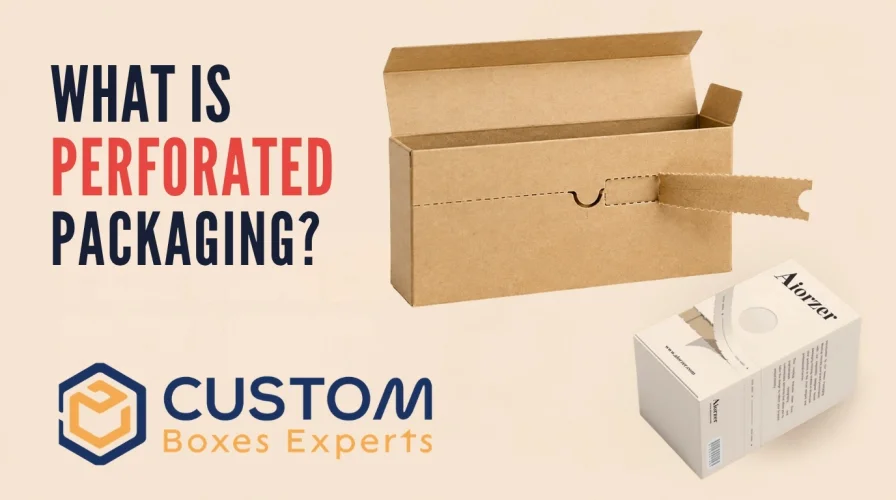
Smart ways of storing products that not only keep products secure but also allow hassle-free access for buyers without using any sharp cutting devices are needed in today’s retail industry.
A partnership with Custom Boxes Experts will help you utilize state-of-the-art die-cutting technology to make retail display boxes. These boxes not only increase structural strength but also result in savings in material and are therefore advantageous from an economic standpoint.
What is Perforated Packaging?
Perforated packaging is a type of printing in which small holes or tear lines are strategically positioned to create a paperboard, cardboard, or plastic sheet with a perforated pattern. These intentional cuts make it easy for consumers to open, tear, and/or separate compartments without scissors or knives.
This design is extremely functional, as well as an attractive, functioning counter-top exhibit. Several world brands are now using these special styles to enhance customer satisfaction ratings by up to 40% on average.
The Technical Process of Perforation
Packaging engineers will employ cutting-edge rotary dies or laser cutting systems to make accurate punctures in order to produce these products. The strength of the custom box can be determined by the number of cut spaces in the paperboard, referred to as the tie-to-cut ratio.
Well-balanced cuts will not tear prematurely in transit and will open easily for the customer pulling on the package. Opting for quality custom product boxes ensures your structure design keeps your product safe and makes it easy to access without tools.
Why Perforated Packaging Is Popular
In recent packaging studies of consumers, 75% of all consumers choose to buy packages that are easier to open than the traditional tightly sealed packages. This desire has gotten many e-commerce and retail brands to abandon traditional, non-functional boxes.
These designs are best loved by retailers because they allow their staff members to open shipping boxes and stock shelves in half the time. Further, the decrease in outer plastic wraps enables businesses to comply with the stringent global sustainability targets and save on their carbon footprint by 15%.
Four Main Types of Perforated Packaging
It is important to know about various types of perforation so that businesses can select the most suitable ones for their shipping requirements. There are four main types of perforated packaging.
1. Micro-Perforation
This style features tiny holes that enable gases to move out and prevent moisture from building up within the box. The micro-perforations are essential to food manufacturers to ensure that fresh berries, vegetables, and hot bakery products don't spoil in transit.
2. Macro-Perforation
Macro-perforation has larger and visible circular holes for quick airflow to cool temperature-sensitive products in cold storage buildings. When buying Custom Printed Cardboard Boxes with macro-perforations, you can prevent moisture from accumulating and mold buildup during long trips.
3. Tear-Line Perforation
This process allows cutting straight or curved lines, dotted cuts, and enables the user to easily and rapidly remove sections without damage. It is the typical size for tissue boxes, cereal boxes, and retail counter displays in grocery stores.
4. Ventilation Perforation
Wasted cardboard corners are eliminated from hot meals with these cuts strategically placed to allow steam to escape. This technique is used by fast food chains to maintain the crispy and crunchy appearance of their fried food and pizzas while they are being transported.
Common Uses of Perforated Boxes in Different Industries
Numerous big industries use these smart packaging solutions to make their product look good, improve logistics, and increase sales. Brands will invest in perforated cardboard display boxes that make it easy to move products from the shipping truck right to the store's shelves.
Let's look at some common uses for perforated boxes across various industries.
Food and Beverage
Pizza boxes have lids with holes so that they can be easily removed, making them into useful, convenient, and reusable cardboard plates for customers. Tear-away pouches allow snack multipacks to be broken up into individual snack servings, allowing parents to control how much their kids eat when they are out and about.
Retail and Cosmetics
Luxury cosmetics companies use tear-away decorative panels, which expose a beautifully designed inner glass bottle on a retail cosmetics shelf. Luxury manufacturers can use specialised custom boxes and packaging to make a stand on packed retail shelves and also shield fragile products.
Pharmaceuticals
Medical blister cards feature perforated lines between each pill compartment, which enable patients to safely and cleanly dislodge daily doses. This easy feature ensures that if a foil packet is accidentally punctured, no other foils will be affected, meaning other medication is sterile and protected from contamination.
Deep Dive into the Benefits of Perforated Packaging
These smart features are beneficial not only for shipping but also for customer satisfaction and retail marketing for brand managers. This eliminates the need for scissors and reduces the risk of accidents and possible injuries while unboxing the product.
Also, companies can print promotional coupon codes on the tear-away panels so that customers will make repeat purchases and will have more loyalty towards the company. The boxes fold flat when not being used, making recycling easy and promoting good environmental hygiene habits.
These versatile containers can be used as shipping cartons as well as retail shelves, which optimizes retailers' limited warehouse space. If a business Orders Custom Printed Boxes that are of high quality, they will have precision machinery that will make clean tears without fiber. When you open them, your precious items will look nice without paper dust on them, thanks to the clean tears.
Comparing Perforated vs. Non-Perforated Packaging
The right structural design needs to be determined by making a side-by-side comparison of the perforated product with standard (non-perforated) options. The table below outlines the functional differences to consider when choosing your brand's packaging.
Feature / Benefit | Perforated Packaging | Non-Perforated Packaging |
Opening Mechanism | Tool-free, manual tear lines | Requires scissors or utility knives |
Air Circulation | High breathability with custom airflow | An airtight barrier against the atmosphere |
Retail Shelf Readiness | Converts instantly into display units | Requires manual unpacking and stocking |
Primary Industry Use | Food, cosmetics, fast-moving consumer goods | Electronics, heavy hardware, liquid goods |
Moisture Control | Prevents condensation and mold buildup | Protects completely from outdoor humidity |
While standard containers offer superior dust protection, perforated options provide unmatched retail convenience and functional ventilation benefits. Combining both styles allows brands to optimize their supply chain while delivering excellent, hassle-free unboxing experiences to buyers.
Sustainability and Economic Impact
Lightweight logistics is one of the main targets for modern logistics managers whose primary concern is decreasing the growing overseas shipping costs. Perforated paperboard designs reduce the use of plastic tape, thereby lowering overall material costs and accelerating processes for custom boxes and packaging lines.
How to Design the Perfect Perforated Box
Designing the ideal perforated box is a straightforward task. It is very important to work closely with professional structural design engineers who are aware of the directions of the cardboard grain to make an effective tear strip. Cutting against the grain will involve cutting deeper, whereas cutting with the grain will involve smaller cuts to avoid tearing.
It is strongly recommended to test prototypes with real products to verify that the box will not be damaged in the shipping process. A trusted manufacturer will ensure that your packaging is guaranteed to work from the factory to the customer's door.
Conclusion:
Using easy-tear features in your product presentation is one of the best ways to make it more convenient and build brand loyalty. The flexible options cover all kinds of sensitive goods and turn any shipping container into an attractive retail showcase in one go. Modern, breathable cardboard designs are guaranteed to bring your products to life, appealingly present them, and open without any problems.
Ready to transform your brand with smart, hassle-free packaging? Our professionals will design perforated boxes that keep your products safe from any kind of damage.
Get a Quote Today from Custom Boxes Experts and give your products the packaging they deserve.
Frequently Asked Questions (FAQs)
What materials are best for perforated boxes?
Sturdiness is best (with easy tearing) with paperboard and corrugated cardboard.
Are shipping cartons weaker if they are perforated?
No, they're still strong thanks to precise engineering techniques that strategically position cuts away from the load-bearing areas.
Can perforated boxes be recycled?
Yes, they are completely recyclable and will decompose more quickly due to the reduced amount of plastic sealing tape.
How does micro-perforation help food items?
It allows steam to escape to prevent sogginess, making bakery products crisp and fresh for a longer period.
Is it expensive to produce perforated tooling?
No, not at all. It will be returned to you quickly as ROI due to faster packing and less tape usage.