





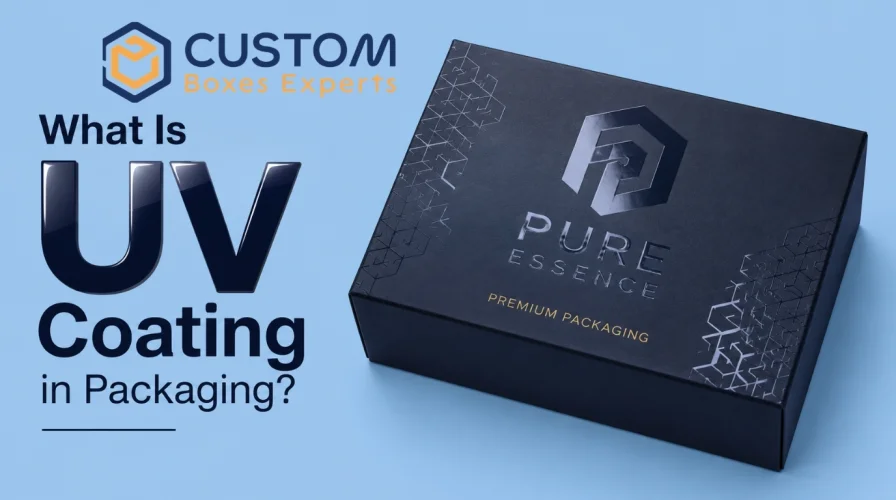
UV coating refers to a clear layer applied to the outer surface of the printed packaging material by employing a highly focused source of ultraviolet light. The contemporary liquid laminate offers very high durability to provide protection to your product packaging from any scratches, dust, or moisture.
By choosing Custom Boxes Experts, you will benefit from our high-end finishing skills, which will distinguish your products from others. With the help of this coating choice, you can add a premium quality finish to your retail products.
Why Is UV Coating Important in Printing and Packaging?
Your product packaging appearance becomes the initial impression that customers get regarding your brand products. Utilization of a high-quality liquid finish becomes an important component in making sure your retail packaging looks good and durable.
From the data collected via the global market research, the current value of the global UV curable resins market size stands at USD 5.7 billion in 2023. It is expected to reach more than USD 11.2 billion in 2032 at a compounded annual growth rate (CAGR) of 6.5%. From this statistic, it can be noted how quickly modern industries are adopting advanced coating techniques.
Adopting this advanced technique ensures that the images printed onto your material will stay crisp, colorful, and safe from damage due to vigorous handling in transit through retail stores.
UV Coating Types and Their Packaging Uses
Various types of coatings will enable the brand to create particular textures or visual effects on its cardboard or paper packaging.
UV Coating Type | Appearance and Reflection | Packaging Uses |
High-Gloss UV | Highly reflective, shiny finish that makes printed colors pop | Retail food boxes, standard folding cartons, and electronics packaging |
Matte UV | Smooth, non-reflective, elegant surface that feels highly luxurious | Artisanal chocolate boxes, organic cosmetics, and luxury gift packaging |
Spot UV | Applied selectively only to specific design elements or logos | Highlighting brand names, key graphics, or patterns on dark boxes |
Raised UV (3D) | Thicker formulation that mimics an embossed, dimensional texture | Perfume boxes, premium spirits, and limited-edition product packaging |
Soft-Touch UV | Velvety, suede-like finish that feels incredibly soft to touch | Luxury jewelry boxes, high-end cosmetics, and premium electronics |
Pearlescent UV | Lustrous, shimmering, multi-toned iridescent glow | Beauty creams, cosmetics jars, luxury skincare packaging |
Orange Peel UV | Textured, slightly bumpy, slip-resistant grip | Heavy-duty retail boxes, specialized industrial packaging |
Key Differences: UV Coating vs. Lamination
Lamination can be obtained through the application of a thin layer of plastic substance onto the paperboard substrate through heating and pressing. The packaging solution that you will obtain through this technique will have a lot of strength and tear resistance qualities, which makes it suitable for packaging in rigid structures, such as custom-made necklaces.
On the contrary, the UV coating technique involves applying a liquid layer on the paperboard substrate, which will harden instantly after exposure to light without the use of a plastic layer. The procedure is less expensive, faster, and environmentally friendly, which makes it a better choice for regular products like custom retail boxes and packaging.
Major Advantages of UV Coating
Dazzling Visual Appearance: Dark colors such as black and blue appear very rich and wet because of their glossy surface.
Fast Drying Process: The paint dries very quickly due to light exposure, thus decreasing the whole manufacturing process significantly.
Eco-friendly Solution: Such coatings do not contain any solvents and do not release any volatile organic compounds during fast drying.
Premium Branding: A small finishing touch will allow you to make luxurious custom boxes that customers will appreciate.
Detailed Logos: This technology allows making even the smallest text on the logo more noticeable for the consumer.
Brand Reputation: High-quality marketing materials with a glossy finish indicate the success of your business among your target audience.
Drawbacks and Limitations to Keep in Mind
Coating such papers that are very lightweight with a liquid will lead to curling of their fibers during the drying process. Cured surfaces are very smooth, and hence it will be very difficult to use a ballpoint pen or stamp to write on them.
Moreover, there are cases when heavy coatings on paperboard lead to cracking of the box at the folds. You should not use such coatings on folded sections of boxes since they require durability when bent extremely.
Besides, such coatings are highly prone to fingerprints. This is the case with packaging materials that are matte black.
Compare the Pros and Cons of UV Coating
To help you make an informed choice, here is a breakdown of the key features of this finish:
Feature | Pros | Cons |
Appearance | Provides a sharp, bold, mirror-like gloss or luxurious matte finish | Matte variations can easily show fingerprints and smudges |
Quality | Excellent for making specific elements or logos pop dynamically | May cause white paperboard surfaces to yellow over time |
Durability | Excellent protection against surface abrasion, fingerprints, and light moisture | Cured coatings become rigid, which can lead to cracking if folded |
Production Speed | Hardens in seconds under UV lamps, removing long drying times | Requires specialized equipment, inks, and highly trained press operators |
Environmental | Contains zero solvents and emits no volatile organic compounds | Thicker chemical coatings can complicate standard paper recycling processes |
Common Coating Problems and Solutions
Managing a professional printing press requires careful attention to detail to prevent common application issues on your boxes.
1. Sticky Surfaces (Incomplete Curing)
This may be due to excessively high belt speeds or loss of curing capacity of the light bulbs. The solution to this problem is lowering the belt speed or replacing the light bulbs to increase their intensity.
2. Peeling or Flaking (Poor Adhesion)
This is caused by the failure to ensure that the ink printed on the surface dries completely before application of the protective layer. Printers solve this problem through the use of ink sets or by adding a primer to bind the layers.
3. Bubbles or Foaming
Bubbles result from excessively high speeds of pumps, which trap air within the liquid protective coating during printing. Defoamer added to the protective coating eliminates this problem.
How This Finish Enhances Process Efficiency
Traditional solvent coatings require massive gas-powered ovens and hours of drying time before they can be physically handled. In contrast, ultraviolet curing uses photoinitiators that polymerize the liquid into a solid film in less than a second.
Industrial conveyor lines can run at speeds of 600 to 800 feet per minute during the application process. Because the material cures instantly, your custom packaging can be stacked, packed, and shipped immediately without any factory downtime.
Industries Utilizing This Finishing Method
It is common practice for many international businesses to opt for ultraviolet-coated cardboard boxes that will help protect their products on retail shelves. The beauty industry opts for soft-touch coating for its Cosmetic Boxes, while the tech industry opts for spot gloss coating for its mobile phone boxes.
Moreover, gourmet foods and luxury distilleries opt for textured coatings that give them luxury packaging. All these types of coating will ensure that your customized box packaging remains fingerprint-free.
Automotive: It is used for protecting the dashboard components, headlights, and interior plastic parts from damage caused by sunlight exposure on a regular basis.
Electronics: Used on circuit boards and cell phones as an insulator material, and has excellent scratch resistance.
Furniture: It makes the finishes of top-quality wooden flooring, cabinets, and office furniture extremely resistant to chemicals.
Medical devices: Provides biocompatible coating on medical equipment, ensuring total safety.
Selecting the Right Finish for Your Brand
If you want your product colors to pop on retail shelves, a glossy flood coating is your best option. However, if you want a minimalist, luxurious look, pairing a matte background with spot gloss logos works wonders.
Ordering custom wholesale boxes allows you to add these premium finishes while keeping your per-unit packaging costs incredibly low. It is always recommended to rely on experts to pick out the proper paperboard weights and prevent common problems such as curling and cracking.
Selecting the proper vendor is essential for your custom designs to be printed flawlessly. Our specialists will give you a free consultation and help you to pick the best combination of inks, paper, and coatings.
Create Premium Packaging Today: Contact our friendly sales representatives to get an instant quote and start your next project!
Frequently Asked Questions (FAQs)
What are the main types of UV coating?
High gloss, matte, selective spot, raised 3D, soft touch, pearl, and textured orange peel are some common finishes.
Is UV coating water-resistant during shipment?
It protects against minor moisture and raindrops, but it does not make paper boxes entirely waterproof.
Can I write on a UV-coated box?
Standard ink pens and stamps will smudge easily on this slick, cured plastic-like protective surface layer.
What is the difference between flood and spot UV?
Flood UV is the coating of the whole box surface, and Spot UV is applied selectively on parts of the box.
Are UV-coated boxes environmentally friendly?
Yes, UV-coated boxes are eco-friendly since the thin plastic layer is removable during the conventional pulping process.